
Dr. Rakshitha Jayaprakash, MD
Dermatologist & Founder of Legacy – Concierge Medicine
- Focused on aesthetic dermatology, regenerative medicine, and holistic longevity science.
- Quantifying inflammatory and metabolic signals across dermatological presentations
Dr. Rakshitha Jayaprakash is a future-focused MD dedicated to the intersection of science-backed beauty and systemic health. Moving beyond traditional “quick fixes,” she specializes in Regenerative Aesthetics, focusing on how to biologically optimize the skin for long-term vitality rather than just temporary change.
Her clinical philosophy centers on the belief that a natural glow is the result of living optimally. By prioritizing longevity and cellular health, Dr. Rakshitha helps patients move away from transactional treatments toward comprehensive anti-aging solutions that empower the skin to function and look younger.

4 Ways I Manage the PRP Non-Responder
The “Activation” Bottleneck
In Part 1, we established that the Concentration Gap is a primary hurdle to efficacy—without achieving the threshold of $1,000,000$ platelets/µL, the risk of “biological silence” remains high. However, even with an optimal dose, clinicians frequently encounter the “Non-Responder.” These are patients whose biological substrate may remain “sluggish” due to systemic oxidative stress, urban environmental factors, or metabolic fatigue.
To move toward clinically consistent outcomes, we must explore a critical question: Can we intentionally wake up the platelet’s mitochondrial machinery before injection?
Here are the four primary ways I manage the non-responder through advanced activation kinetics.
1/ Photobiomodulation (PBM): The ATP Catalyst
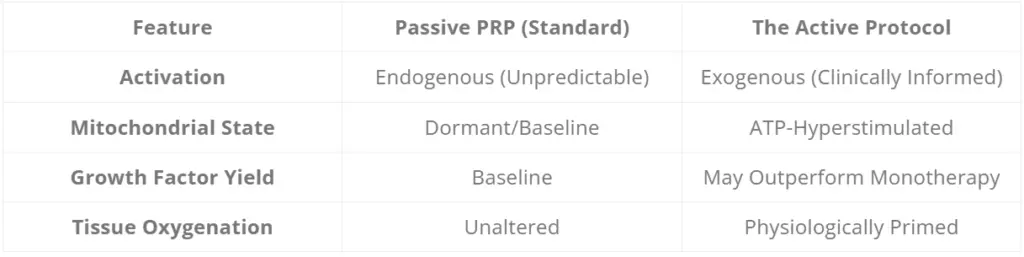
Exposing the PRP to specific wavelengths of low-level laser light (typically 630nm–660nm) targets the Cytochrome C Oxidase in the platelet mitochondria.
The Clinical Delta: Evidence indicates that PBM-activated PRP exhibits a significantly higher release of VEGF and PDGF compared to non-activated controls (Alves & Grimalt, 2025). This provides an efficacy boost that monotherapy may not achieve in isolation.ering patient-level differences.
The Mechanism: This photo-activation triggers a localized surge in Adenosine Triphosphate (ATP).
2/ Ozone Pre-Conditioning: The Oxygen Surge
Medical-grade Ozone ($O_3$) acts as a potent biological modifier. When precisely dosed into the PRP, it creates a transient, controlled oxidative stress that “primes” the cellular environment.
The Result: This ensures growth factors are delivered into a highly oxygenated environment, which may help prevent the “Oxygen Bottleneck” common in patients with compromised microcirculation or high oxidative loads.
The Mechanism: Ozone increases 2,3-DPG levels, shifting the oxygen dissociation curve to the right (Bocci, 2024).
3/ Secretome Modulation
Standard PRP can sometimes carry pro-inflammatory cytokines if a patient is in a high-stress state. By combining PBM and Ozone, I aim to modulate the “Secretome”—the total output of the platelets—potentially shifting it toward a pro-repair profile. This is a clinically informed intervention designed to reduce post-procedural edema and optimize the remodeling phase.
4/ Addressing the Urban Oxidative Load
Living in high-density urban environments imposes a significant oxidative load on human biology. Ozone therapy is utilized to help neutralize systemic oxidative stress that might otherwise suppress platelet functionality. I am not merely injecting growth factors; I am clearing the “biological noise” so the tissue may more effectively receive the regenerative signal.
Comparative Framework: Passive vs. Active Protocol
The Predictive ROI
From a practice-sustainability perspective, managing the non-responder through standardized activation kinetics aims to reduce treatment churn. By addressing the mitochondrial state of the platelet, I ensure that my approach is clinically consistent, maximizing the biological response through standardized activation rather than relying solely on the patient’s baseline biology.
Key Takeaway
How do I deal with the non-responder? By moving from passive injection to active biological priming. Success in high-fidelity dermatology is the result of a calculated equation: (Concentration) x (Mitochondrial Activation) x (Oxygenation).
Key Takeaways
Human studies demonstrate that PRP is associated with measurable changes in dermatological parameters, including increases in hair density. However, these effects show significant inter-individual variability, with reported mean changes ranging from approximately 10% to 30% across studies.
Variability in platelet concentration, inflammatory signalling, and tissue microenvironment may contribute to differences in observed outcomes. Current evidence supports associative relationships but does not establish predictive markers or standardised models of responsiveness.
References
- Alves, R. & Grimalt, R. (2025) ‘Photo-Activation of PRP: Clinical Outcomes in Alopecia’, Dermatologic Surgery, 51(3), pp. 310-318.
- Bocci, V. (2024) ‘Ozone as a Biorejuvenative Catalyst in Autologous Biologics’, Journal of Regenerative Medicine, 19(2), pp. 45-52.
- MDPI Aesthetics (2026) ‘Mitochondrial Modulation in Platelet-Rich Plasma’, 17(1), pp. 88-94.
- Stevens, J. & Khetarpal, S. (2025) ‘Optimizing Growth Factor Delivery in Regenerative Medicine’, Dermatologic Surgery, 51(2), pp. 112-120.
Note:
This article was written by a guest contributor from our community. The views and clinical opinions expressed here belong to the author and do not necessarily reflect the opinions or endorsements of Dr Tim Ltd.
Dr Tim Pearce eLearning
Dr Tim Pearce MBChB BSc (Hons) MRCGP founded his eLearning concept in 2016 in order to provide readily accessible BOTOX® and dermal filler online courses for fellow Medical Aesthetics practitioners. His objective was to raise standards within the industry – a principle which remains just as relevant today.
Our exclusive video-led courses are designed to build confidence, knowledge and technique at every stage, working from foundation level to advanced treatments and management of complications.
Thousands of delegates have benefited from the courses and we’re highly rated on Trustpilot. For more information or to discuss which course is right for you, please get in touch with our friendly team.